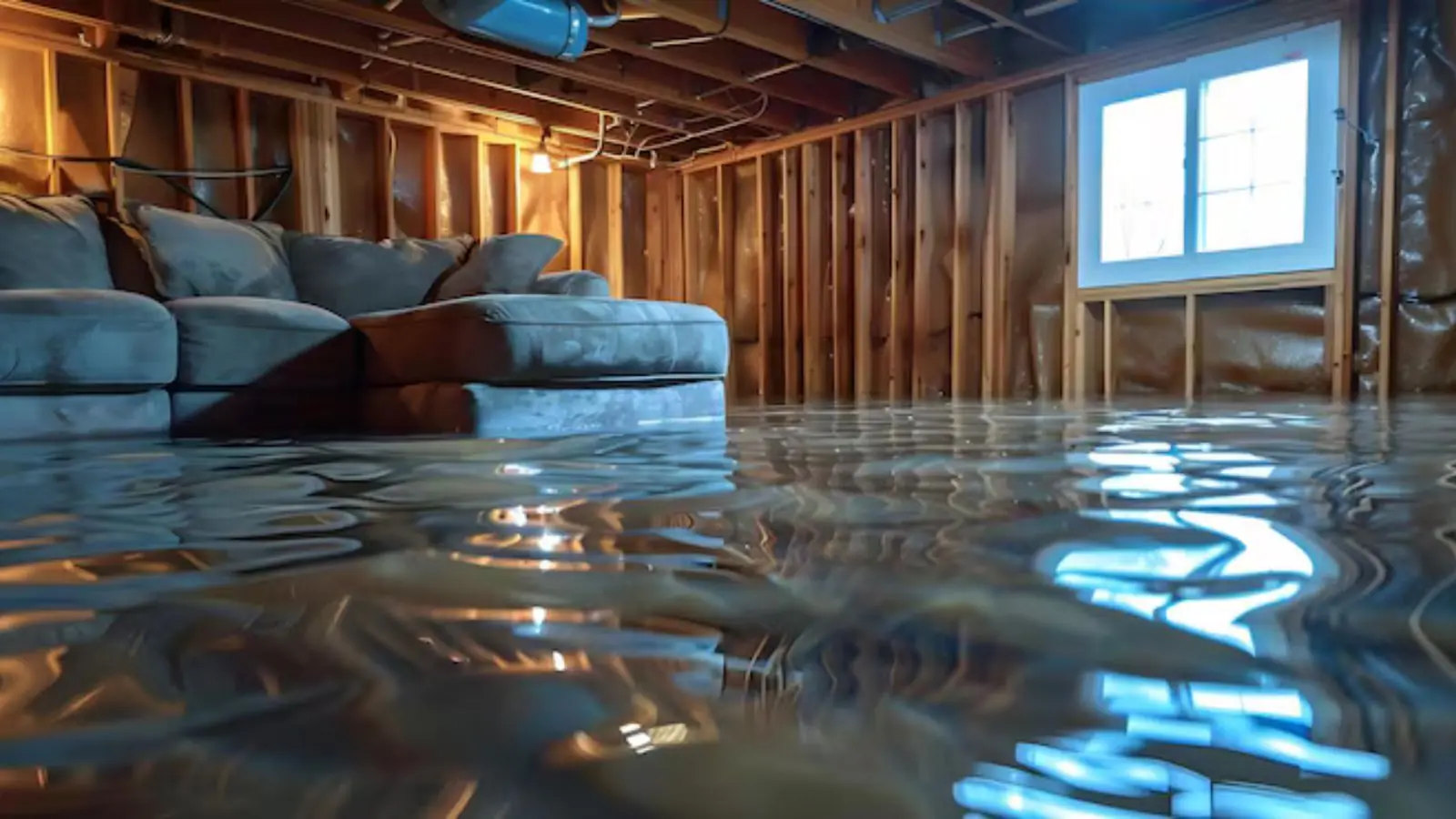
You open the door to the stairs and the bottom three steps are underwater. Or the below-grade garage floor is dark and shiny, or the crawl space smells like wet dirt. Water below ground level behaves differently from a leak on an upper floor, because it has nowhere to drain and it keeps arriving until the source is stopped.
This guide is for any property with a basement, below-grade garage, utility room or crawl space. It sorts the likely sources, lays out the first hour, explains what gets pulled out versus what gets dried, and shows how the drying works. Use it to make good decisions while you wait for help.
Find the source before anything else
Four sources account for most below-grade water. Groundwater seepage comes through the slab or the foundation wall after heavy rain, usually along a crack or the joint where wall meets floor. A failed sump pump overflows its pit when the float sticks or the power goes off. A split supply line or a water heater tank gives way and puts clean water into the room. A sewer backup pushes wastewater up through the floor drain.
The source decides almost everything that follows. Clean supply water can often be dried in place, while sewage forces a stricter tear-out. Timing is a good tell. Water that appears during or after rain points to groundwater or the sump, water on a dry day points to plumbing, and water rising from a floor drain with a foul smell points to the sewer line.
Water category and source at a glance
ANSI/IICRC S500, the industry standard for water damage restoration, sorts water into three categories. Category 1 is clean, Category 2 is gray and Category 3 is black, meaning grossly contaminated. Below-grade water can start in one category and slide into the next the longer it sits, so the table shows the typical starting point, not a promise.
| Water category | Typical source | What is done |
|---|---|---|
| Category 1 (clean) | Broken supply line, water heater leak, failed fixture | Extract standing water, dry in place with air movers and dehumidifiers, remove only materials that will not dry |
| Category 2 (gray) | Sump pump overflow, washing machine or dishwasher discharge, long-standing Category 1 | Extract, remove wet carpet and pad, cut baseboard and drywall as needed, clean and treat surfaces, then dry |
| Category 2 to 3 | Groundwater seepage carrying soil and runoff | Extract, remove porous finishes, wash and treat the slab and wall base, dry and monitor |
| Category 3 (black) | Sewer backup through a drain or toilet, rising surface flooding | Stay clear, remove all porous materials that touched the water, disinfect surfaces, then dry and verify |
Water or mold problem right now?
Call the 24/7 line and describe what you see.
The first hour
Safety comes before the water. If the electrical panel is dry and you can reach it without stepping into water, switch off power to the area. If the panel is wet, or you would have to wade to reach it, stay out and call the utility or 911. The same goes for the smell of gas near a water heater or furnace.
Once the space is safe, the goal is to stop more water coming in and to start the clock on drying. EPA guidance says that drying wet materials within 24 to 48 hours generally prevents mold growth, and below-grade rooms hold humidity longer than rooms above ground. Call early, because standing water and wet drywall do not wait for business hours.
- Shut off the main water valve if a pipe or water heater is the suspected source.
- Unplug nothing that sits in or near standing water. Cut power at the panel only if it is dry and reachable.
- Photograph the waterline on the walls and the items that were affected before anything moves.
- Lift furniture legs onto foil or plastic blocks and move small valuables upstairs.
What gets removed and what gets dried
Crews sort a wet basement into two piles. Porous materials that soak up water and cannot be cleaned, such as carpet pad, insulation, particleboard cabinets and drywall that sat in contaminated water, usually go. Hard, dense materials such as concrete, framing lumber and tile can be cleaned and dried in place.
Drywall is the judgment call. In clean water, a wall wet only near the floor can sometimes be flood cut about 12 to 18 inches above the waterline so the cavity can air out. In gray or black water, the wet section is removed and the studs are cleaned. Wet insulation in the wall cavity almost always comes out, because it holds moisture against the framing for days.
Stored items matter too. Cardboard, paper and fabric wick water upward and are the first things to grow mold, so sort them into keep, clean and discard piles. Our flood work is handled under below-grade flood restoration, and the pump-out stage falls under emergency extraction.
How a below-grade space is dried
Extraction comes first. Truck-mounted or portable pumps pull standing water, then weighted extractors pull water out of whatever carpet is being kept. After that, the job becomes a humidity problem. Air movers push dry air across wet surfaces, and low-grain refrigerant or desiccant dehumidifiers pull the moisture out of the air so it does not settle back into the walls.
Basements are slow to dry because concrete holds water and the air is often cool and still. Crews place moisture meters and thermo-hygrometers, record readings on day one, and recheck daily. Equipment stays until wall and slab readings match a dry reference point, which can take several days. Pulling it early is a common reason a space smells musty a week later.
- Standing water is pumped out first, then the slab is squeegeed and extracted.
- Wet baseboard, lower drywall and pad are removed so the cavity can breathe.
- Air movers and dehumidifiers run around the clock with daily moisture readings.
- Surfaces that touched gray or black water are cleaned and treated before drying.
Cutting the cause so it does not repeat
Drying does not fix the source. Test a sump pump with a bucket of water and ask whether it has a battery backup and a working check valve. For seepage, a licensed contractor can assess grading, gutters and downspouts. For a sewer backup, a plumber can camera the line to find the blockage.
New drywall, baseboard and flooring after the dry-out are a separate stage from mitigation. They fall under post-flood repairs and rebuild, and it helps to keep the two line items separate on paper. Flood damage is usually excluded by insurers and backup often needs an endorsement, so check your policy.
Below-grade water around Montebello and nearby cities
Montebello sits about 8 miles east of downtown Los Angeles, with the Rio Hondo along its eastern side. Whether your property has a basement, a below-grade garage, a utility room or a crawl space, the location tells you little by itself, so check the FEMA Flood Map Service Center for your address instead of guessing. If you are near the river or low-lying streets, ask your insurer whether flood coverage is on your policy.
Water service in Montebello comes from four providers listed by the city: California Water Service, Montebello Land & Water Company, San Gabriel Valley Water Company with the City of Montebello Water Department, and South Montebello Irrigation District. The city page does not say which serves which address, so look at your water bill. That is the company to call when a supply line breaks.
Crews working in the area also cover neighboring cities. If you are on the Monterey Park side, see our page on Monterey Park water damage crews. For the Pico Rivera side, between the Rio Hondo and the San Gabriel River, see Pico Rivera restoration help.
Common questions
How long does a flooded basement take to dry?
It depends on the water category, the size of the space, the materials and how soon extraction starts. Concrete and framing hold moisture, so several days of equipment time is common, and the crew decides based on daily moisture readings, not a fixed schedule.
Will insurance cover groundwater or a sewer backup?
Often not by default. Sudden and accidental water damage may be covered, but flood damage is usually excluded, and sewer backup often needs a separate endorsement. Check your policy or ask your insurer.
What should I do if I find water in my Montebello basement at night?
Stay out of standing water, shut off the main valve if a pipe is the source, cut power only if the panel is dry and reachable, and call a 24/7 dispatch line right away. If you smell gas or see sparks, leave and call 911.