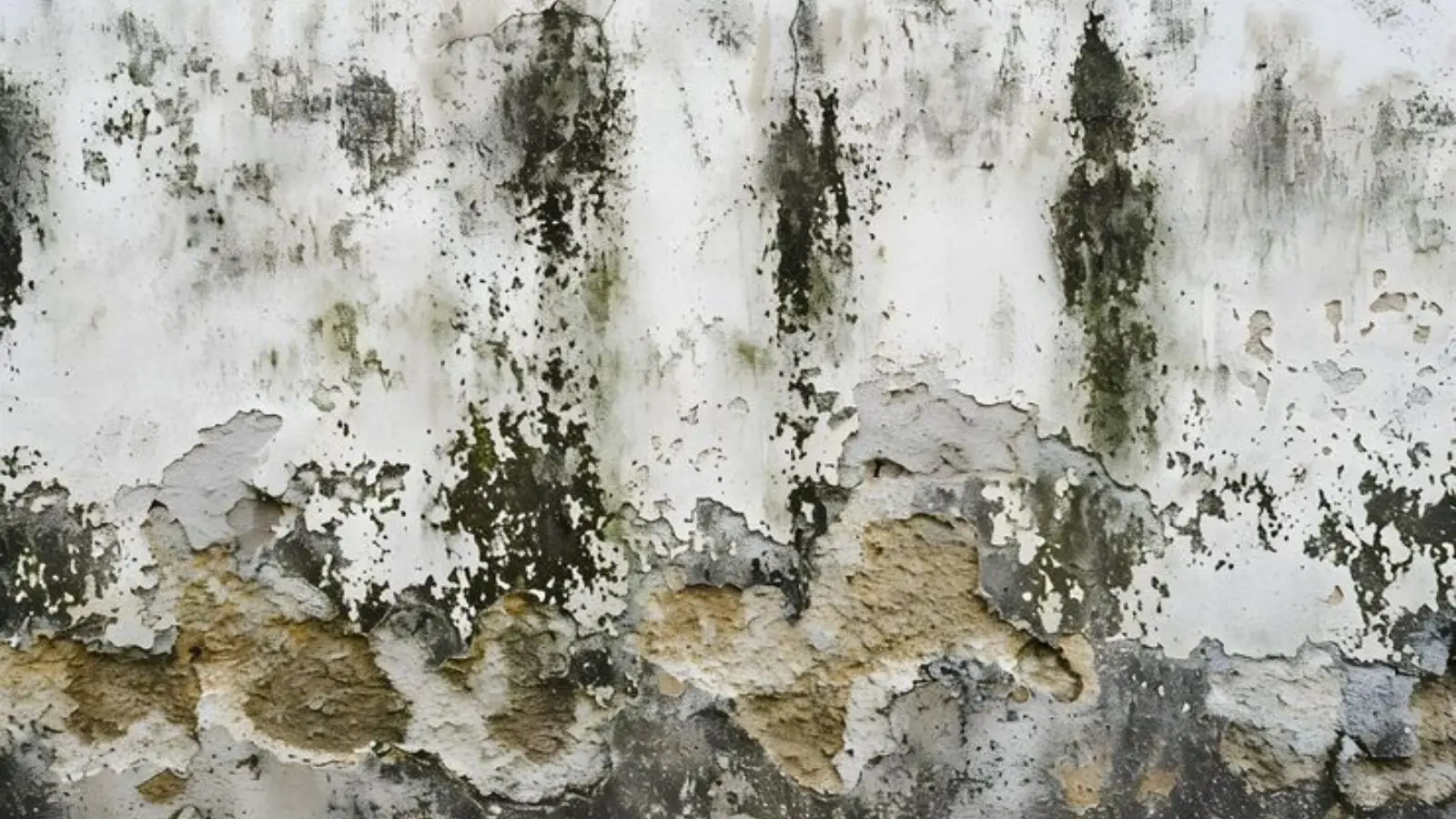
A gray-green bloom on a below-grade wall looks about the same from across the room whether it sits on poured concrete or on the paper face of drywall. Up close it is a different problem. The material decides how deep growth can travel, what a moisture meter can tell you, and whether the job is a cleaning or a demolition.
This guide goes through the four wall types most often found in below-grade rooms, separates efflorescence from mold, and explains what meter readings are actually for. It applies if your property has a basement, below-grade garage, utility room or crawl space. Mold needs moisture, so every section comes back to where the water is coming from.
Start with what the wall is made of
Poured concrete is dense and cures into a nearly solid mass. Growth on it usually lives in the surface film of dust, paint or sealer rather than inside the concrete itself. Concrete block is another story, because each unit has hollow cores and the mortar joints between them let water travel behind a painted face.
Painted drywall and wood furring are the porous materials. Drywall is a gypsum core wrapped in paper, and wet paper feeds mold quickly. Furring strips are thin wood battens fastened to masonry to hold drywall or paneling, and they sit in a gap where air barely moves and moisture lingers.
| Wall material | What to look for | Usual approach |
|---|---|---|
| Poured concrete | Dark or fuzzy film on the surface, damp patches after rain, hairline cracks that weep | HEPA vacuum, damp wipe with detergent, dry the wall, then trace and stop the water source |
| Concrete block | Staining along mortar joints and the lowest courses, bubbling paint, damp cores | Strip failed paint, clean the face, dry the cores with air movement and dehumidification |
| Painted drywall | Spots under paint, crumbly or soft edges, peeling paper, musty smell behind baseboards | Cut out and bag the affected sheets with a margin past visible growth, then dry the cavity |
| Wood furring | Dark growth on faces and back sides, soft spots when probed, rusted fasteners | Clean and dry sound wood with light staining, replace strips that are soft or deeply stained |
Efflorescence is not mold, but it is a warning
Efflorescence is a white, powdery or crystalline deposit left when water moves through masonry, dissolves salts, and evaporates at the surface. You will see it on concrete and block and almost never on drywall. The deposit is not alive, but it proves water is passing through the wall, and that is the same condition mold needs.
Efflorescence is usually pale and brittle and brushes off dry. Mold tends to be fuzzy, spotty or smeared, in colors from gray to green to black, and it often leaves color on a damp cloth. Neither can be confirmed by looks alone, and the two often share a wall, so treat the white crust as a moisture flag and inspect the area around it closely.
- Wipe one small spot with a damp paper towel and see whether it leaves color or just dissolves white.
- Probe drywall edges and furring with a screwdriver tip. Soft material is a replace decision, not a clean decision.
- Check the lowest 2 feet of the wall first, because water wicks up from the floor.
- Note whether stains follow a pipe, a window well or a floor crack.
- Stop and call a professional if the affected area looks larger than about 10 square feet, roughly 3 feet by 3 feet, which is where EPA guidance points to professional help.
Water or mold problem right now?
Call the 24/7 line and describe what you see.
What moisture meter readings are for
A moisture meter does not detect mold. It reads water, and the number means different things on different materials. A pin meter measures wood and drywall by resistance between two probes, while a pinless meter scans below the surface through a flat sensor pad. On bare concrete and block the absolute number is much less reliable, so crews use it to compare a suspect spot against a dry reference spot on the same wall.
The real value is trend. A technician logs readings on day one, sets air movers and a dehumidifier, and logs them again each day. Wet spots should fall toward the reading of the dry reference. If they stall, there is probably an active source behind the wall, and more equipment will not fix it.
Readings also draw the boundary of the work. EPA guidance says drying wet materials within 24 to 48 hours generally prevents mold growth, so wet drywall that has sat longer is a removal candidate even before growth shows. ANSI/IICRC S500 covers water damage and S520 covers mold remediation, and you can ask any company whether its crews work to them.
What can be cleaned and what has to come out
Hard surfaces such as sealed concrete can usually be cleaned, because growth sits on top. Cleaning means HEPA vacuuming, damp wiping and drying, not painting over a stain. EPA does not recommend routine bleach use for mold cleanup, and bleach does nothing about the water that fed the growth.
Porous materials are different. Once growth runs through drywall paper, insulation or soft furring, wiping the face does not reach the inside, so removal is the usual approach. Before cutting, a crew builds containment from plastic sheeting and runs a HEPA air scrubber so spores are not pushed into the rest of the house. That is the stage where a remediation crew earns its keep, and the follow-up drying is the job of water mitigation equipment.
Any health question about exposure belongs with a physician. Testing and remediation follow S520.
Fix the water before you touch the wall
A cleaned wall that stays damp can grow again, so the source comes first. Common culprits are downspouts that dump beside the foundation, soil sloped toward the house, a cracked foundation wall, a weeping window well, a pinhole in a supply line, and condensation on cold masonry. Mapping where readings are highest narrows the list.
If you see standing water near outlets, a sagging ceiling, or smell sewage or gas, stay out of the room. Cut power only if the panel is dry and reachable, and call the utility or 911 for electrical or gas hazards.
Montebello below-grade rooms and who to call about a wet wall
Montebello sits about 8 miles east of downtown Los Angeles, with the Rio Hondo along its east side next to Pico Rivera. Nobody should assume a given house has a basement, so look at what you actually have: a below-grade garage, a utility room, or a crawl space. Walls facing the street or a slope are the first to check for seepage, and your city building department can tell you what permits apply before any wall is opened.
The City of Montebello website lists four water providers for residents and businesses: California Water Service, Montebello Land & Water Company, San Gabriel Valley Water Company with the City of Montebello Water Department, and South Montebello Irrigation District. The page does not say which serves which address, so check your water bill. If the damp patch is near a meter or service line, call that provider about a leak check before cutting into anything.
If seepage seems tied to heavy rain or runoff, check the FEMA Flood Map Service Center for your address. The same material-by-material checks apply to relatives or tenants across the river, and the dispatch team can also talk through properties in Pico Rivera or Rosemead.
Common questions
Can I just paint over mold on a basement wall?
No. Paint hides the stain but leaves the growth and the moisture in place. On porous material the growth is also under the surface, so the wall has to be cleaned or removed first, then dried and checked with a meter.
Does mold grow inside concrete block?
Growth is usually on the surface, in the paint film, or on organic material touching the block. The hollow cores can hold water, though, so a damp block wall needs drying at the core level, not only a surface clean.
Should I buy a test kit to identify the mold?
A kit can show that spores are present, but it cannot tell you what to do about a wet wall. The decision rests on moisture readings, the material and the size of the area, so start there.
Who should I call about a wet basement wall in Montebello?
Check your water bill to learn which of the four listed Montebello water providers serves you, and call them if a leak near a meter is possible. For drying, containment and removal, call the 24/7 dispatch line and describe the wall material and how large the stain is.