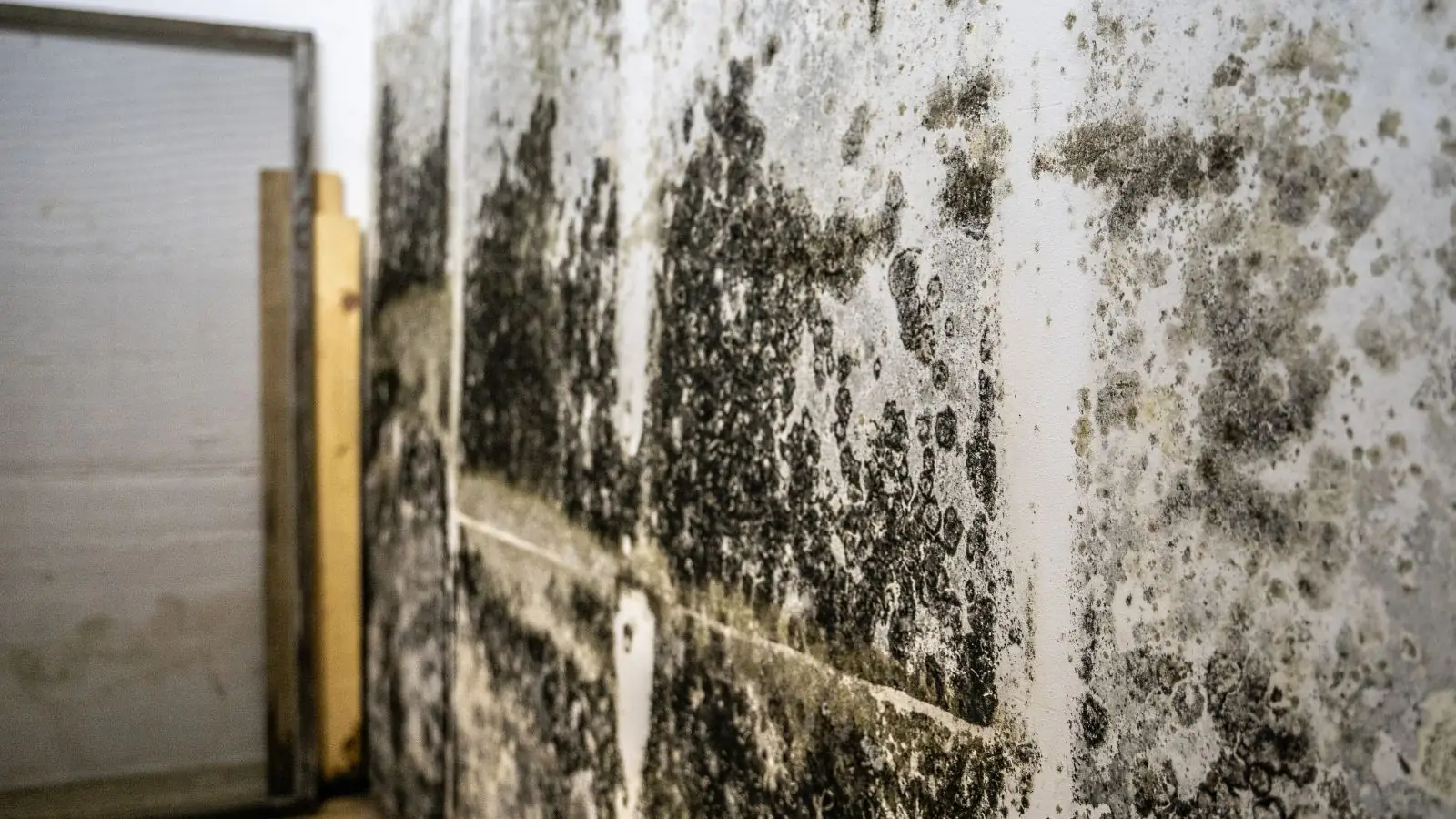
Here is the decision rule in one line. Fix the moisture first, measure the moldy area second, and let the size of that area tell you whether you handle it or hire it out. Everything else in this guide hangs off those three steps.
It applies to any property with a basement, below-grade garage, utility room or crawl space. These spaces are cool, often poorly ventilated and in contact with soil and concrete, so they stay damp longer than rooms above ground.
Step one: stop the moisture
Mold needs moisture, so removal without a fix is a short-term cleanup. Walk the space and look for the wet source. Common ones are a leaking pipe, a sump pump that stopped working, a dryer vent that exhausts into the room, a gutter that drops water against the foundation wall, or a past flood that was never fully dried.
Check the less obvious spots too. Look behind stored boxes, along the base of walls, around the water heater and at the underside of any floor above. A cheap hygrometer shows relative humidity, and readings that stay high point to a ventilation or seepage problem that cleaning will not solve.
If water is still present, the job starts there. Standing water and wet materials fall under water mitigation and drying, and the mold work comes after the structure is dry.
Step two: size the area
EPA guidance points to professional help when a moldy area is larger than about 10 square feet, roughly 3 feet by 3 feet. Measure the visible growth with a tape, then add the area behind anything that is stained, soft or musty. A patch on a wall that continues behind drywall is usually bigger than it looks.
Remember that visible size is a minimum. Growth inside a wall cavity or under carpet cannot be measured by eye, so a musty smell with no visible mold is still a reason to call. Questions about how mold affects your health belong with a physician.
Water or mold problem right now?
Call the 24/7 line and describe what you see.
Area size and the sensible approach
The table maps the size of the problem to a practical path. It follows the EPA 10 square foot guidance and the general approach of ANSI/IICRC S520, and a crew can adjust it after inspecting the space.
| Area size | Situation | Approach |
|---|---|---|
| Under 10 sq ft | Small surface growth on a hard, non-porous surface, cause already fixed | DIY is reasonable with gloves, an N95 respirator, eye protection, detergent and water, then dry thoroughly |
| About 10 sq ft | Borderline patch, or growth on drywall or wood | Get an inspection, because porous materials often have growth below the surface |
| Over 10 sq ft | Larger patch, or any growth on drywall, insulation or carpet | Professional remediation with containment, HEPA filtration and removal of affected materials |
| Widespread, or after sewage | Growth across several walls or the floor, or Category 3 water involved | Professional remediation to S520 with a written scope and clearance check |
What DIY can and cannot do
A small patch on concrete, tile or sealed wood can be scrubbed with detergent and water, then dried completely. EPA does not recommend routine bleach use for mold cleanup. Bleach also adds moisture to the surface, which does not help a room that was already damp.
Porous materials are a different story. Drywall, insulation, carpet, cardboard and unsealed wood absorb growth and cannot be fully cleaned. Scrubbing them mostly spreads spores, and dry-brushing a moldy wall puts them in the air.
- Wear an N95 respirator, gloves and goggles, and keep children and pets out.
- Do not run a fan that blows across the moldy area toward the rest of the home.
- Do not paint or caulk over growth, because it keeps feeding under the film.
- Bag removed material in plastic before carrying it through the house.
- Stop and call if the patch grows, the smell returns or material is soft.
Containment and HEPA, in plain words
Containment means sealing the work area so spores cannot drift. Crews hang plastic sheeting, tape the seams and set up a fan that pulls air out of the room through a filter, which keeps the room at lower pressure than the rest of the house. That is called negative air.
HEPA stands for high-efficiency particulate air. A HEPA vacuum or air scrubber captures very fine particles that a regular vacuum would blow back out. Crews use them to clean surfaces after the moldy material is removed, and to filter the air while they work.
What a professional job looks like
A job to S520 starts with an inspection and moisture readings, then containment, removal of affected material, HEPA cleaning and drying. Sampling, when it is used, is a separate step and should not replace fixing the moisture. After the work, a clearance check confirms the space is ready for rebuild.
Our mold remediation service page lays out the process, and the repair work afterward falls under reconstruction and repair. Ask any company whether its crews work to S520, and ask for the scope in writing. No one can promise that mold will not return, because that depends on whether the space stays dry.
Mold in below-grade spaces around Montebello
Basements are not the typical Montebello home, so the advice here is for properties that have them, along with below-grade garages, utility rooms and crawl spaces. If yours is one, ask your city building department about permits before you open walls. For flood exposure, check the FEMA Flood Map Service Center for your address instead of assuming.
The Rio Hondo runs along the east side of Montebello, and Whittier Boulevard and State Route 60 cross the area. None of that tells you whether your space will get damp, so use a hygrometer and your own inspection. If a pipe is the source, check your water bill to see which of the four providers listed by the city serves you, since the city page does not match providers to addresses.
Nearby cities have their own crews on call. See the page for Monterey Park below-grade water help or the one for Rosemead drying and mold support.
Common questions
Can I just clean basement mold with bleach?
EPA does not recommend routine bleach use for mold cleanup. Detergent and water on hard surfaces, followed by thorough drying, is the usual approach for a small patch.
How big is too big for DIY?
EPA guidance points to professional help for an area larger than about 10 square feet, roughly 3 feet by 3 feet. Growth on porous materials like drywall also deserves an inspection at any size.
Do I need mold testing first?
Not always. Visible growth plus a moisture source is often enough to act on. If you want sampling, it should follow S520 protocols and should not delay fixing the moisture.
Will mold come back after removal?
No one can promise it will not, because mold needs moisture. If the space stays dry and ventilated after remediation, the conditions that fed it are gone.
Does a Montebello basement need a permit for mold work?
That is a question for your city building department, since rules depend on the work. Ask before you open walls or replace structural material.